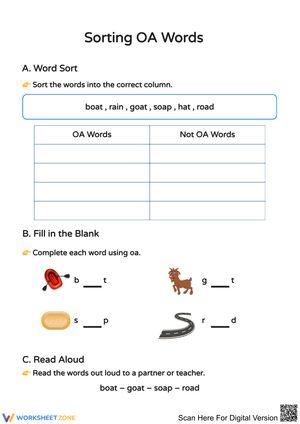
Developing a robust understanding of fundamental mathematical operations is paramount for young learners. Among these, grasping the concept of multiplication as equal groups forms a crucial cornerstone for future mathematical proficiency. Practice materials specifically designed to address this interpretive skill play a vital role in solidifying early learning. These structured learning tools provide focused opportunities to internalize the meaning behind multiplication expressions, moving beyond mere rote memorization to a deeper conceptual comprehension. Effective engagement with such resources empowers students to build a strong foundation in numerical reasoning, paving the way for success in more complex algebraic thinking. Explore more in our Math Worksheets collection.
💡 Educational Key Takeaways:
- Core Skill: Structured 3 Oa A 1 Worksheets focused on developing pencil grip, stroke control, and early literacy/math confidence.
- Target Scope: Suited for homeschoolers, preschool, kindergarten, and elementary learners.
- Best Recommendation: Practice 10–15 minutes daily with ergonomic writing tools to reinforce muscle memory without hand fatigue.
The principal benefits of engaging with these targeted learning materials revolve around fostering a profound conceptual understanding of multiplication. Instead of simply calculating answers, students learn to interpret multiplication sentences as representations of real-world scenarios involving equal groups. This approach significantly aids in the development of problem-solving skills, as it requires students to visualize and model mathematical situations. Furthermore, these resources support critical thinking by prompting learners to connect abstract symbols with concrete quantities, thereby enhancing their ability to apply mathematical concepts in varied contexts. The visual and hands-on nature often incorporated into these practice sheets also caters to diverse learning styles, ensuring a more inclusive and effective learning experience. For more related activities, check out our 5th Grade English Worksheets.
Typically, the structure of these educational resources is thoughtfully designed to guide students through the interpretive process. They commonly feature a progression of activities, starting with visual representations like drawing arrays or groups of objects to match multiplication equations. Activities may then advance to writing repeated addition sentences that correspond to given multiplication problems, reinforcing the connection between addition and multiplication. Other common elements include matching scenarios to appropriate multiplication expressions and solving word problems that require interpreting products of whole numbers in terms of equal groups. Each section is usually presented with clear instructions and ample space for students to demonstrate their understanding through drawings, written explanations, or numerical answers. Discover more free resources across our collection library.
To maximize the learning potential from these practice sheets, a structured approach is recommended. Begin by reviewing the core concept of “equal groups” with the learner, using physical manipulatives or real-world examples to illustrate the idea. Next, work through the initial questions together, modeling how to interpret the multiplication expression and represent it visually or through repeated addition. Encourage students to articulate their thought process, explaining why a particular drawing or number sentence is appropriate. Once a solid understanding of the task is evident, allow for independent practice, providing support as needed. After completion, review the answers collaboratively, discussing any misconceptions and reinforcing correct understanding. Emphasizing the process of interpretation over merely finding the correct answer is key.
Further enriching the learning experience involves integrating these practice materials with a variety of supplementary strategies. Consider incorporating educational games that reinforce the concept of equal groups or using interactive online tools that offer dynamic visual models of multiplication. Encourage learners to identify and discuss real-life instances of equal groups, such as the number of wheels on a certain number of cars or cookies in several bags. Regular, short practice sessions are often more effective than infrequent, long ones. Additionally, exploring related practice materials that cover similar standards or build upon these foundational skills can provide a comprehensive and continuous learning pathway. Positive reinforcement and celebrating small victories will maintain motivation throughout the learning journey.
In conclusion, the strategic use of these interpretive multiplication practice sheets is instrumental in cultivating a deep and lasting understanding of mathematical operations. They offer an invaluable opportunity to develop essential skills in conceptualization, problem-solving, and critical thinking, laying a robust foundation for future academic success. The clear structure and focused content enable learners to master the crucial ability to interpret products of whole numbers as equal groups. Exploring and incorporating these carefully crafted educational resources into a learning regimen is highly encouraged, as they significantly contribute to building confidence and fostering a genuine appreciation for mathematics.
Developmental Milestone & Activity Table
| Development Stage | Recommended Daily Duration | Primary Learning Objective |
|---|---|---|
| Preschool & Pre-K | 10 – 15 Minutes | Pencil grip development & basic pre-stroke lines |
| Kindergarten | 15 – 20 Minutes | Letter/number formation & spatial line awareness |
| Early Elementary (Grade 1–2) | 20 – 30 Minutes | Fluency, sentence construction & neatness |
Images References