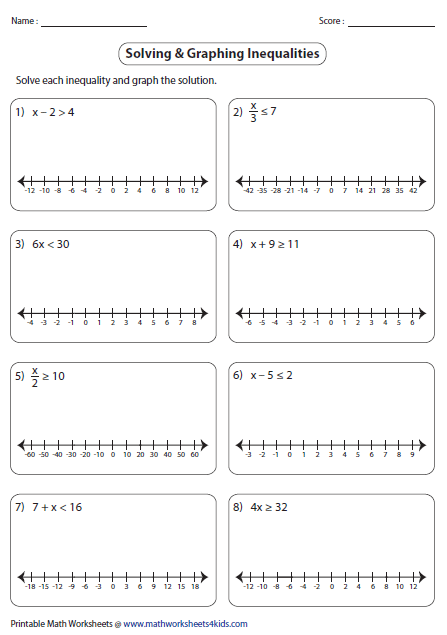
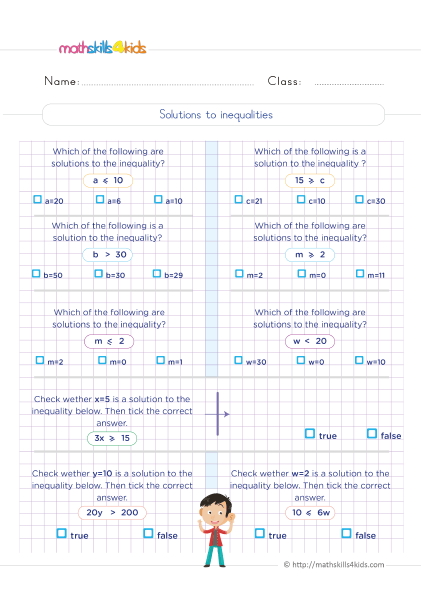
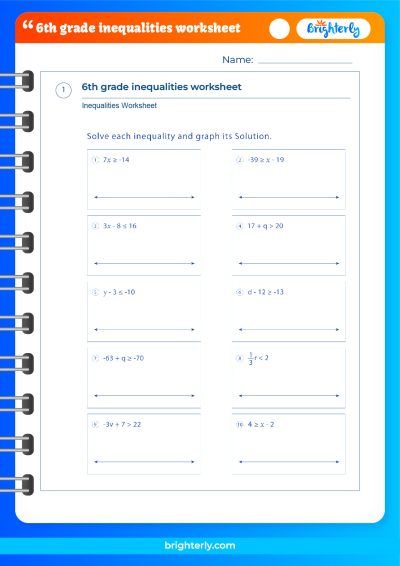
Understanding the relationships between numbers is a cornerstone of mathematical proficiency. This particular educational resource offers a focused approach to mastering mathematical comparisons for students at an important developmental stage. It introduces and reinforces the critical skills necessary for discerning when one quantity is greater than, less than, or simply not equal to another. Engaging with such material builds a robust foundation, preparing learners for more complex algebraic reasoning and problem-solving encountered in later studies. Explore more in our Math Worksheets collection.
💡 Educational Key Takeaways:
- Core Skill: Structured Inequalities 6th Grade focused on developing pencil grip, stroke control, and early literacy/math confidence.
- Target Scope: Suited for homeschoolers, preschool, kindergarten, and elementary learners.
- Best Recommendation: Practice 10–15 minutes daily with ergonomic writing tools to reinforce muscle memory without hand fatigue.
Utilizing this type of learning tool yields several significant advantages. It clarifies the distinction between equivalent and non-equivalent mathematical expressions, fostering precision in numerical interpretation. Learners develop crucial problem-solving skills by analyzing various scenarios that require comparing different values. Furthermore, it enhances critical thinking abilities as students are prompted to evaluate and justify relationships between numbers, moving beyond simple arithmetic. This practice is instrumental in strengthening number sense and provides essential groundwork for future mathematical endeavors, including the manipulation of variables and solving algebraic equations. For more related activities, check out our Division Sheets With Answers.
Typically, the structure of such a learning aid is thoughtfully designed to facilitate progressive understanding. It commonly begins with a clear introduction to the fundamental symbols: greater than (>), less than (<), greater than or equal to (), less than or equal to (), and not equal to (). Subsequent sections often feature activities that require comparing two given numbers or basic expressions. There may be exercises for identifying true or false comparative statements, tasks involving the insertion of the correct comparison symbol, and even simple word problems that necessitate translating real-world scenarios into mathematical comparisons. Clear examples are usually provided to guide learners, with the complexity of questions gradually increasing to challenge developing skills. Discover more free resources across our collection library.
To maximize the learning potential from this worksheet, a systematic approach is recommended. First, dedicate time to thoroughly understand the meaning and application of each comparison symbol. Next, work through any provided examples diligently to internalize the methodology before attempting independent problems. Then, proceed through the exercises methodically, concentrating on accurately evaluating the quantities presented. Upon completing sections, it is beneficial to verify answers, perhaps against an answer key, to identify any areas requiring further review. Consistent practice is vital for solidifying comprehension and building confidence, and whenever difficulties arise, seeking clarification from an educator or peer is always encouraged.
Beyond the immediate tasks, several additional strategies can deepen understanding. Visualizing comparative relationships on a number line can offer a powerful spatial understanding. Creating real-world examples, such as comparing temperatures, distances, or quantities of objects, helps connect abstract concepts to tangible experiences. Engaging in discussions about various comparison scenarios with others can also broaden perspectives. Exploring supplementary online interactive tools or educational games that reinforce comparative principles can make learning both enjoyable and effective. If any foundational concepts regarding numerical values seem unclear, reviewing them can provide a stronger base for this subject matter. Seeking out additional practice materials focused on similar mathematical comparisons can further enhance mastery.
Engaging with this educational resource offers a valuable pathway to mastering fundamental mathematical comparisons. Its benefits extend from strengthening basic number sense to laying crucial groundwork for advanced algebraic thinking. Consistent practice with these types of materials is instrumental in fostering a strong mathematical foundation. Learners are encouraged to continue exploring these concepts, downloading similar worksheets, and utilizing all available resources to cultivate lasting mathematical proficiency and confidence.
Developmental Milestone & Activity Table
| Development Stage | Recommended Daily Duration | Primary Learning Objective |
|---|---|---|
| Preschool & Pre-K | 10 – 15 Minutes | Pencil grip development & basic pre-stroke lines |
| Kindergarten | 15 – 20 Minutes | Letter/number formation & spatial line awareness |
| Early Elementary (Grade 1–2) | 20 – 30 Minutes | Fluency, sentence construction & neatness |
Images References