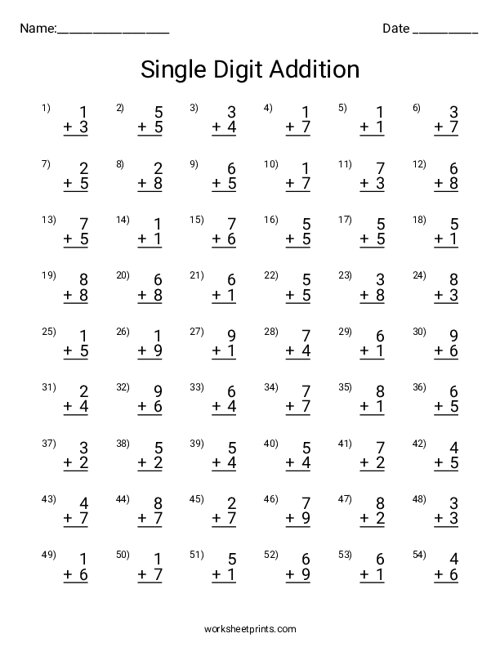
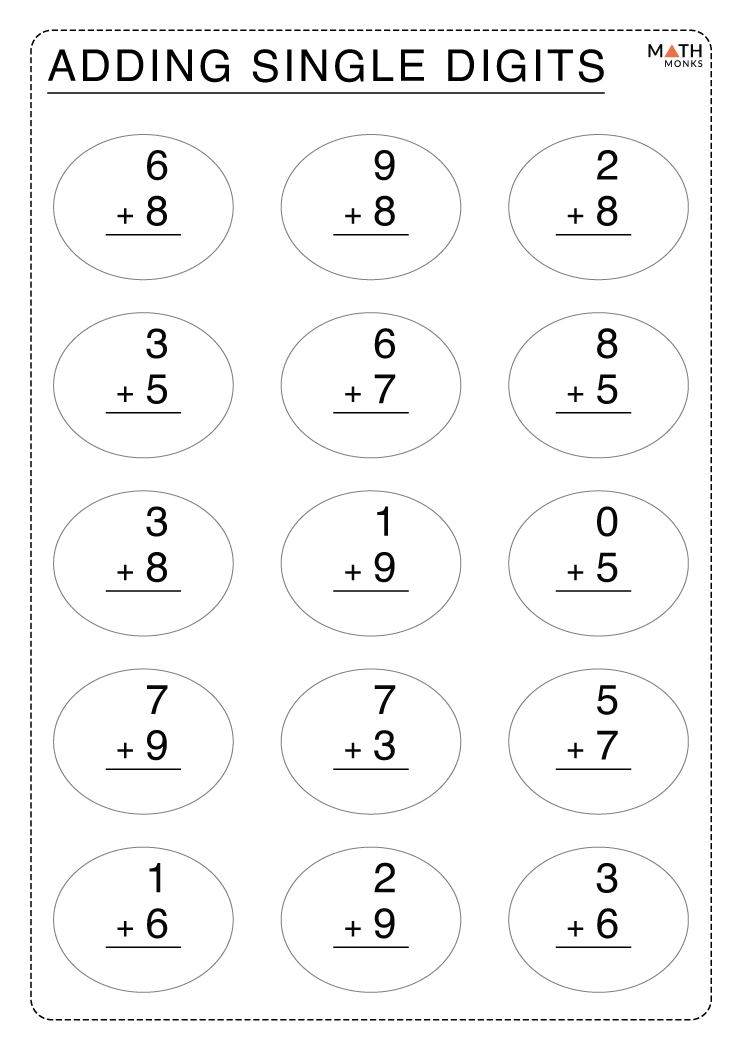
The mastery of fundamental arithmetic serves as the cornerstone for all subsequent mathematical understanding. A dedicated resource focusing on initial numerical operations plays a pivotal role in establishing this essential foundation. This particular worksheet provides a structured approach to understanding how numbers combine, fostering early confidence and laying the groundwork for more intricate mathematical concepts. It is an indispensable tool for developing a robust numerical intuition and preparing learners for their ongoing mathematical journey. Explore more in our Math Worksheets collection.
💡 Educational Key Takeaways:
- Core Skill: Structured One Digit Addition focused on developing pencil grip, stroke control, and early literacy/math confidence.
- Target Scope: Suited for homeschoolers, preschool, kindergarten, and elementary learners.
- Best Recommendation: Practice 10–15 minutes daily with ergonomic writing tools to reinforce muscle memory without hand fatigue.
Engaging with materials that simplify complex ideas yields significant learning benefits. This specific worksheet aids in developing numerical fluency, enhancing the quick recall of basic arithmetical facts, and cementing the conceptual understanding of quantitative changes. It is instrumental in cultivating strong mental math capabilities, which are vital for daily problem-solving and higher-level mathematics. Through repeated, focused practice, learners can solidify their grasp of combining small quantities, building both accuracy and speed in their calculations. For more related activities, check out our Kuta Software All Transformations.
The structure of this educational resource is designed for clarity and progressive learning. It typically features a series of simple numerical challenges involving single numerals. These problems are often presented in various formats, including horizontal equations (e.g., 3 + 4 = ?) and vertical stacking, to familiarize learners with different representations of the same operation. Some sections may gradually introduce combinations that result in sums within the first ten, ensuring a gentle progression and sustained engagement with the material. Discover more free resources across our collection library.
To maximize the effectiveness of this learning tool, a systematic approach is recommended. Initially, concentrate on the conceptual understanding of combining quantities, possibly by using physical manipulatives or visual aids like fingers or counters. Regular, short practice sessions are more beneficial than infrequent, long ones. Prioritize accuracy in solving each problem before attempting to increase speed. Reviewing any incorrect answers is crucial for identifying areas that require further attention and reinforcing correct methods. Breaking down the worksheet into smaller, manageable sections can prevent overwhelm and sustain motivation.
Beyond the worksheet itself, there are various ways to enrich the learning experience. Incorporating interactive games or real-world examples of combining small quantities can make the process more engaging and relatable. Exploring related educational materials, such as number lines for visualization, fact families to understand inverse relationships, or subsequent worksheets introducing calculations with two-digit numbers, can significantly extend learning. Patience and consistent effort are paramount, as building foundational mathematical skills is a cumulative process requiring diligent practice.
Ultimately, this valuable resource provides an excellent starting point for any learner on their mathematical path. It helps to construct a solid base in fundamental number operations, boosts confidence in numerical abilities, and cultivates essential analytical skills. Learners are encouraged to fully engage with this material and to explore additional related worksheets and educational resources to continue expanding their mathematical horizons.
Developmental Milestone & Activity Table
| Development Stage | Recommended Daily Duration | Primary Learning Objective |
|---|---|---|
| Preschool & Pre-K | 10 – 15 Minutes | Pencil grip development & basic pre-stroke lines |
| Kindergarten | 15 – 20 Minutes | Letter/number formation & spatial line awareness |
| Early Elementary (Grade 1–2) | 20 – 30 Minutes | Fluency, sentence construction & neatness |
Images References