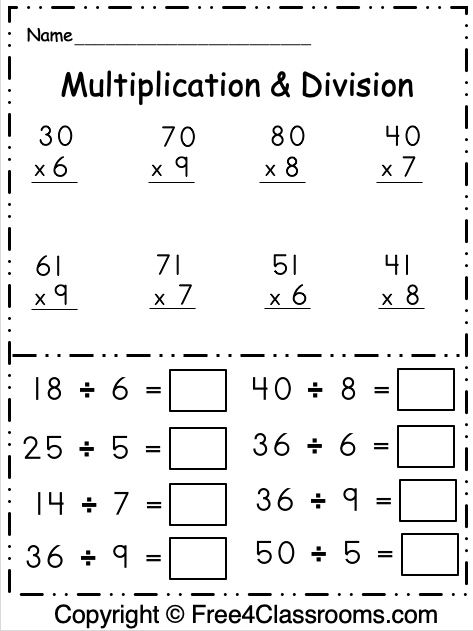
Developing a strong foundation in mathematics during the third grade is a pivotal step in a child’s educational journey. At this stage, learners transition from basic arithmetic to more complex concepts, requiring consistent practice and reinforcement. Supplementary educational materials play a crucial role in solidifying classroom lessons and building confidence in mathematical abilities. Structured practice sheets, readily available for printing, serve as an invaluable tool to bridge potential learning gaps and ensure a comprehensive understanding of core principles. Explore more in our Math Worksheets collection.
💡 Educational Key Takeaways:
- Core Skill: Structured Math Worksheets For 3rd Graders Printable focused on developing pencil grip, stroke control, and early literacy/math confidence.
- Target Scope: Suited for homeschoolers, preschool, kindergarten, and elementary learners.
- Best Recommendation: Practice 10–15 minutes daily with ergonomic writing tools to reinforce muscle memory without hand fatigue.
The utilization of these practice materials offers numerous educational advantages. They provide an opportunity for learners to reinforce newly acquired skills in a focused environment, aiding memory retention and automaticity in calculations. Engagement with varied problem types helps develop critical thinking and problem-solving strategies, moving beyond rote memorization. Consistent interaction with such resources can significantly boost a learner’s self-assurance in tackling mathematical challenges, fostering a positive attitude towards the subject. Furthermore, these materials allow educators and parents to identify specific areas where a learner might need additional support, enabling targeted intervention. For more related activities, check out our Integer Graph.
Typically, these learning aids encompass a broad spectrum of third-grade mathematical concepts. Content often includes advanced addition and subtraction with regrouping, multiplication facts up to 12, introductory division, understanding fractions, basic geometry shapes and properties, measurement (length, weight, capacity), time-telling, money management, and multi-step word problems. The exercises are usually structured to present a variety of question formats, such as computational drills, fill-in-the-blanks, matching activities, true or false statements, and real-world problem scenarios, ensuring a diverse and engaging learning experience. Discover more free resources across our collection library.
To maximize the effectiveness of these learning tools, a structured approach is recommended. First, establish a quiet, dedicated space free from distractions for the learning session. Before beginning, a brief review of the relevant mathematical concept can help refresh the learner’s memory. Encourage independent problem-solving initially, allowing the learner to attempt questions without immediate assistance. After completion, review the answers together, providing constructive feedback for incorrect responses and explaining the correct methodology. Breaking down complex word problems into smaller, manageable steps can also demystify the task. Consistent effort, even in short bursts, proves more beneficial than sporadic long sessions.
Beyond the direct application of these practice sheets, several supplementary strategies can enhance learning. Integrating math concepts into everyday activities, such as calculating change at a store or measuring ingredients for a recipe, helps learners see the practical relevance of their studies. Manipulatives, like blocks or counting beads, can be useful for visualizing abstract concepts, particularly for fractions or multiplication. Exploring various types of supplemental resources, including educational games or interactive online platforms, can provide alternative ways to engage with the subject. Furthermore, seeking out additional materials specifically focused on challenging topics, such as a particular multiplication table or specific fraction operations, can offer targeted practice.
The consistent engagement with accessible mathematical practice sheets is instrumental in cultivating robust mathematical proficiency for third graders. These resources offer a structured pathway for skill development, critical thinking enhancement, and confidence building, ensuring that learners are well-prepared for future academic challenges. The ongoing commitment to utilizing these readily available learning aids will undoubtedly strengthen a learner’s foundational understanding and foster a lasting appreciation for mathematics.
Developmental Milestone & Activity Table
| Development Stage | Recommended Daily Duration | Primary Learning Objective |
|---|---|---|
| Preschool & Pre-K | 10 – 15 Minutes | Pencil grip development & basic pre-stroke lines |
| Kindergarten | 15 – 20 Minutes | Letter/number formation & spatial line awareness |
| Early Elementary (Grade 1–2) | 20 – 30 Minutes | Fluency, sentence construction & neatness |
Images References