Developing foundational mathematical skills is crucial for young learners, setting the stage for future academic success. Among these essential skills, understanding subtraction is a cornerstone of early numeracy. A structured learning resource, designed for kindergarten-level children focusing on numbers 1 through 10, provides an effective means to introduce and reinforce the concept of “taking away.” Such a tool aids in building confidence and competence in basic number operations, making abstract concepts tangible and accessible for emerging mathematicians. Explore more in our Math Worksheets category.
💡 Educational Key Takeaways:
- Core Skill: Structured Subtraction Worksheets For Kindergarten 1-10 focused on developing pencil grip, stroke control, and early literacy/math confidence.
- Target Scope: Suited for homeschoolers, preschool, kindergarten, and elementary learners.
- Best Recommendation: Practice 10–15 minutes daily with ergonomic writing tools to reinforce muscle memory without hand fatigue.
Utilizing targeted learning materials offers numerous benefits for kindergarten students. These resources support the development of number recognition and the fundamental understanding of subtraction as an action of removing items from a group. Engagement with these materials fosters critical thinking skills as children analyze simple problems and determine solutions. Furthermore, the repetitive yet varied nature of exercises helps solidify mathematical concepts, enhancing problem-solving abilities within a manageable numerical range. The act of writing answers also contributes to the refinement of fine motor skills, which are vital for early handwriting development. Related guide: K 5 Math Teaching Resources.
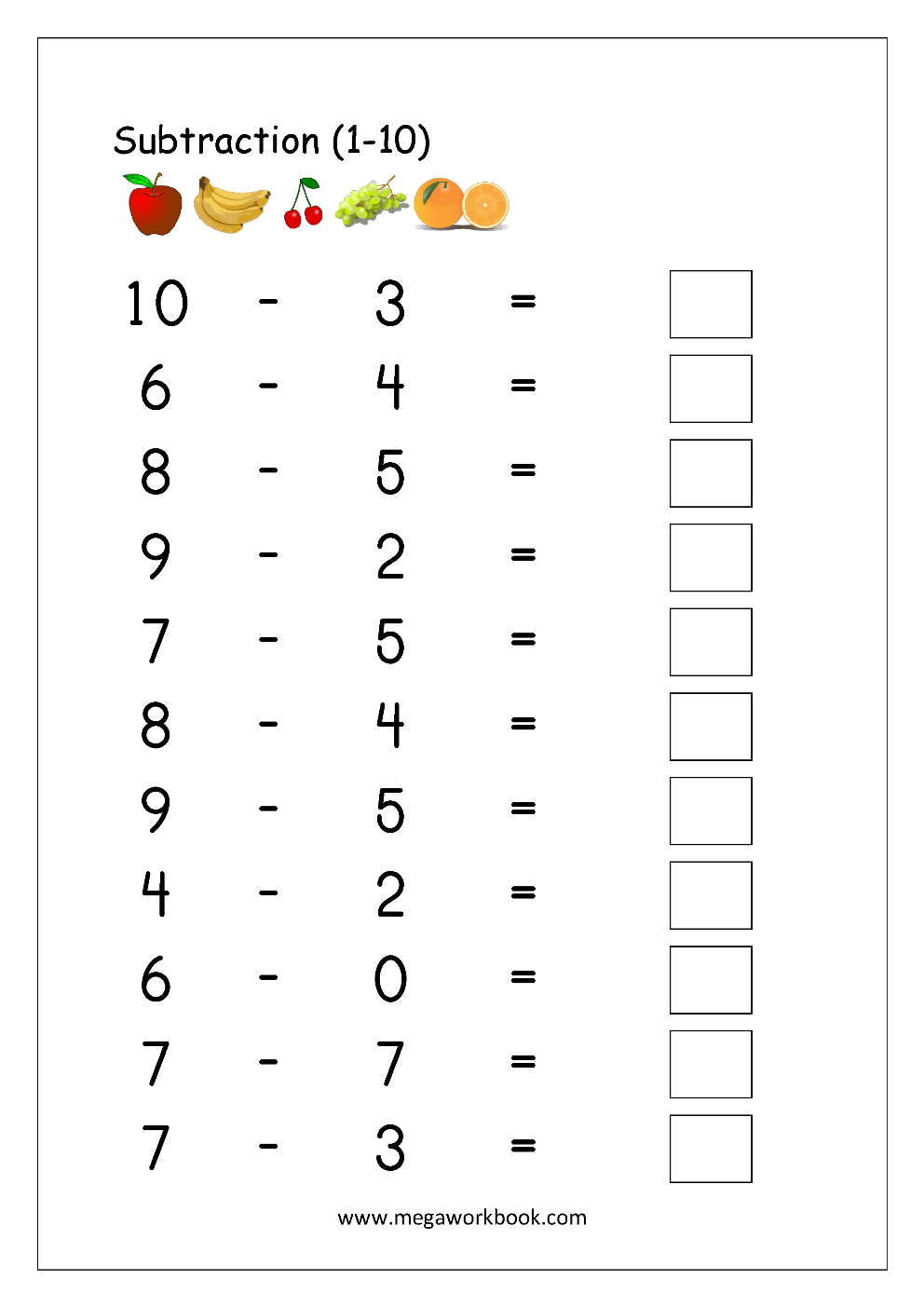
Typically, a learning resource focused on early subtraction within the 1-10 range is structured to be both educational and engaging. It often features simple, clear equations, such as “5 – 2 = ?” presented in a child-friendly format. Visual aids are frequently incorporated, including pictures of objects that can be crossed out, dot patterns, or number lines, to help children visualize the process of subtraction. The content usually progresses in difficulty, starting with very simple problems and gradually introducing slightly more complex scenarios, all while staying within the 1-10 number scope. Ample space for writing answers is provided to encourage active participation and practice. Browse more guides on Cheap Worksheets.
To maximize the effectiveness of these educational sheets, a step-by-step approach is recommended. Initially, it is beneficial to introduce the concept of “taking away” using concrete manipulatives, such as blocks or counters, before transitioning to the printed page. Clearly explain the subtraction symbol and what it signifies. Encourage the use of fingers, drawings, or the provided visual aids to solve each problem, emphasizing the process rather than just the correct answer. Maintain a positive and encouraging learning environment, celebrating small victories to build confidence. Learning sessions should be kept short and focused, perhaps 10-15 minutes at a time, to match the attention span of kindergarteners. Reviewing the completed problems together allows for immediate feedback and reinforcement of understanding.
Beyond the structured activities, supplementing learning with additional tips and resources can further enhance a child’s grasp of early subtraction. Incorporate real-world examples, such as sharing snacks or counting how many toys are left after some are put away. Integrating these concepts into daily routines makes learning practical and relatable. Exploring related materials, such as those focusing on early addition, can help illustrate the inverse relationship between the two operations. Consistency in practice, even for short periods, is key to developing lasting mathematical fluency. Many online platforms and educational publishers offer a wealth of complementary resources that can enrich the learning experience.
In conclusion, a well-designed set of early subtraction practice sheets within the 1-10 range serves as an invaluable tool for developing essential mathematical skills in kindergarten. Its systematic approach to teaching “taking away” fosters conceptual understanding, problem-solving abilities, and fine motor development. By implementing effective teaching strategies and supplementing with real-world examples, educators and parents can significantly contribute to a child’s mathematical foundation. Continued exploration of relevant educational materials is encouraged to support and enrich a child’s ongoing learning journey in numeracy.
Developmental Milestone & Activity Table
| Development Stage | Recommended Daily Duration | Primary Learning Objective |
|---|---|---|
| Preschool & Pre-K | 10 – 15 Minutes | Pencil grip development & basic pre-stroke lines |
| Kindergarten | 15 – 20 Minutes | Letter/number formation & spatial line awareness |
| Early Elementary (Grade 1–2) | 20 – 30 Minutes | Fluency, sentence construction & neatness |
Images References