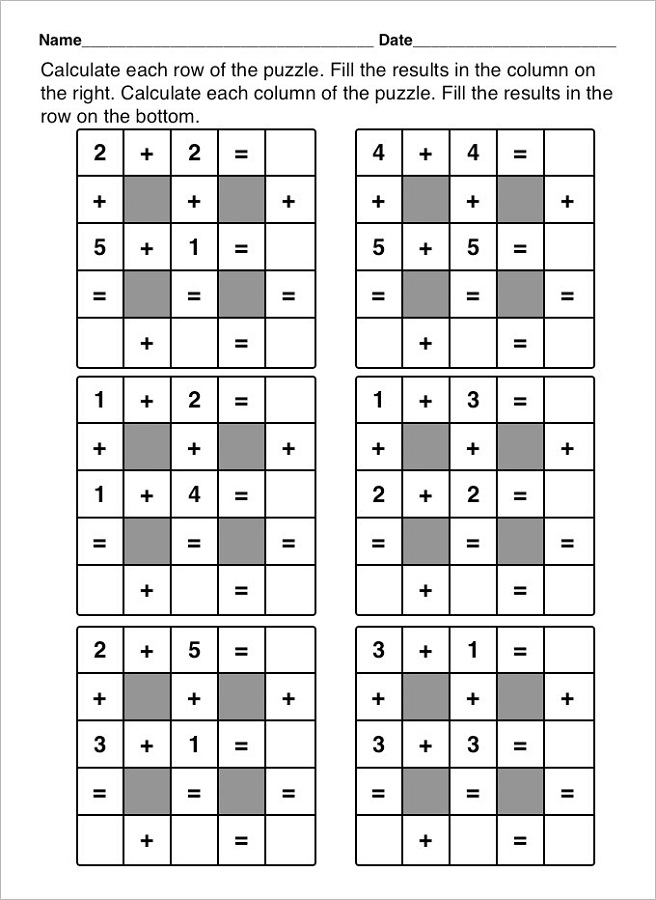
Introduction and Importance of Math Puzzle Sheets
Engaging with mathematical concepts through unconventional methods often fosters a deeper understanding and appreciation for the subject. One such method involves utilizing specifically designed worksheets that transform standard mathematical problems into intriguing mental exercises. These resources play a crucial role in skill development across various learning environments, from the structured setting of a classroom to the self-directed approach of home study. Their importance lies in their ability to motivate learners by presenting math as an enjoyable challenge rather than a rote memorization task. By incorporating elements of fun and discovery, these materials can diminish math anxiety and encourage a more positive attitude toward problem-solving. This ultimately results in enhanced retention and a stronger foundation in fundamental mathematical principles. Furthermore, these materials can adapt to diverse learning paces and styles, catering to the individual needs of each learner. The value of this approach extends beyond simply acquiring mathematical proficiency; it also nurtures critical thinking, logical reasoning, and creative problem-solving abilities.
💡 Educational Key Takeaways:
- Core Skill: Structured Math Puzzle Sheets focused on developing pencil grip, stroke control, and early literacy/math confidence.
- Target Scope: Suited for homeschoolers, preschool, kindergarten, and elementary learners.
- Best Recommendation: Practice 10–15 minutes daily with ergonomic writing tools to reinforce muscle memory without hand fatigue.
Structure and How It Works
The typical layout of these resources often consists of a variety of problem types designed to challenge different areas of mathematical competency. Core Exercises: These usually form the bulk of the material, presenting problems ranging from basic arithmetic to more complex algebra or geometry, depending on the intended skill level. Problems are often framed as riddles, patterns, or sequences requiring careful analysis and deduction to solve. Visual Aids: Diagrams, charts, and other visual components are frequently integrated to enhance understanding and provide alternative ways to approach problems. These elements are especially helpful for visual learners. Interactive Elements: Some worksheets incorporate interactive features like mazes, crosswords, or connect-the-dots, where solutions to math problems dictate the path to follow or the image to reveal. This adds an element of playfulness to the learning process. Answer keys are generally provided to facilitate self-assessment and immediate feedback. These allow learners to check their work and understand where they might have gone wrong. A grading rubric may also be included, enabling educators or parents to track progress and identify areas needing further attention.
Tips and Complementary Resources
Effective utilization of these materials can significantly enhance mathematical proficiency. Daily Practice Tips: Incorporating short sessions dedicated to solving these problems can help reinforce mathematical concepts and improve problem-solving speed. Consistency is key; even a short, focused session each day is more beneficial than infrequent, lengthy sessions. Creating a Positive Environment: Encourage exploration and experimentation, emphasizing the process of problem-solving over simply getting the right answer. Celebrate effort and persistence, and help learners understand that mistakes are a natural part of the learning process. Pairing with Other Resources: These materials can be effectively supplemented with traditional textbooks, online tutorials, and interactive math games. This multi-faceted approach provides a well-rounded learning experience. Consider using these resources as a warm-up activity before tackling more challenging math assignments, or as a fun way to review concepts learned in class. Look for resources that align with the learner’s specific skill level and learning objectives.
Conclusion
These specialized resources offer a valuable and engaging avenue for learning and reinforcing mathematical concepts. By transforming conventional math exercises into captivating challenges, they cultivate a more positive and proactive approach to problem-solving. The benefits extend beyond simply improving mathematical skills; they nurture critical thinking, logical reasoning, and perseverance. The adaptable nature of these materials makes them suitable for a diverse range of learners and learning environments, whether in a structured classroom setting or a self-directed home study program. By embracing this method, individuals can unlock a deeper understanding and appreciation for mathematics, building a solid foundation for future academic and professional pursuits. The integration of this practice into learning regimens is highly encouraged. Explore supplemental materials, such as online problem sets or collaborative group activities, to further enhance the learning experience.
Developmental Milestone & Activity Table
| Development Stage | Recommended Daily Duration | Primary Learning Objective |
|---|---|---|
| Preschool & Pre-K | 10 – 15 Minutes | Pencil grip development & basic pre-stroke lines |
| Kindergarten | 15 – 20 Minutes | Letter/number formation & spatial line awareness |
| Early Elementary (Grade 1–2) | 20 – 30 Minutes | Fluency, sentence construction & neatness |
Images References :
Discover more printable learning activities by visiting our full Fun and Seasonal Math Worksheets archive for teachers, homeschoolers, and parents.