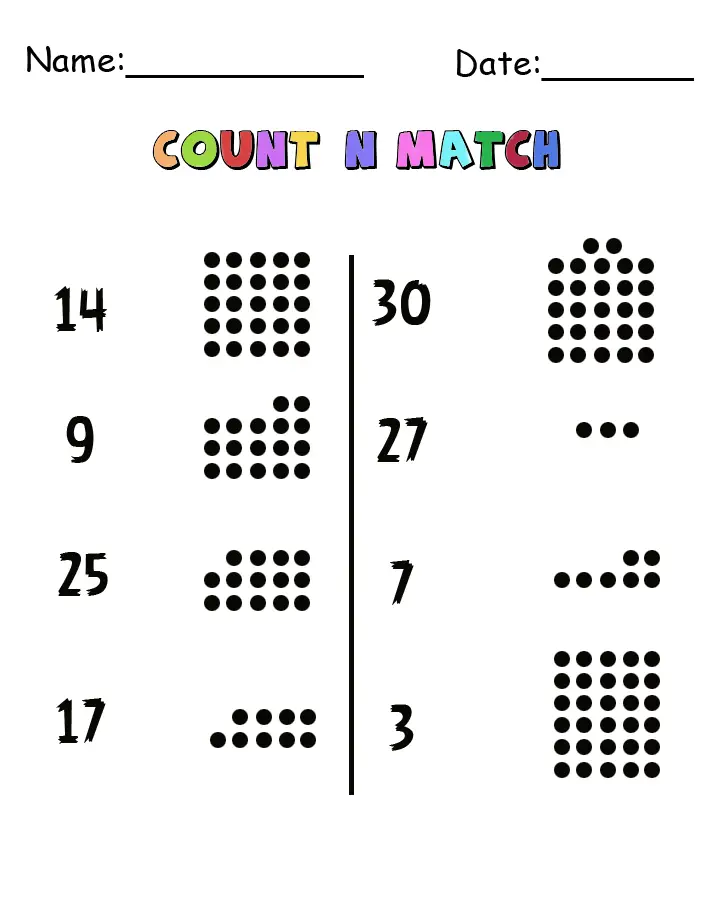
Introduction and Importance of Kindergarten Math Activities Involving Cutting and Pasting
Early mathematical concepts are more readily grasped when presented through tactile and visually engaging activities. Worksheets that incorporate cutting and pasting offer a multi-sensory learning experience, allowing young learners to actively participate in the learning process. These resources transform abstract mathematical ideas into tangible, hands-on experiences. By physically manipulating shapes, numbers, or objects, children develop a deeper understanding of fundamental concepts like counting, sorting, and pattern recognition.
💡 Educational Key Takeaways:
- Core Skill: Structured Kindergarten Math Worksheets Cut And Paste focused on developing pencil grip, stroke control, and early literacy/math confidence.
- Target Scope: Suited for homeschoolers, preschool, kindergarten, and elementary learners.
- Best Recommendation: Practice 10–15 minutes daily with ergonomic writing tools to reinforce muscle memory without hand fatigue.
Such activities are particularly valuable in both classroom and home settings. In a classroom environment, they provide opportunities for collaborative learning and peer interaction. At home, they offer a structured yet enjoyable way for parents to reinforce mathematical skills. The act of cutting and pasting also develops fine motor skills, hand-eye coordination, and spatial reasoning all essential for future academic success. The positive reinforcement and sense of accomplishment derived from completing these activities foster a positive attitude towards mathematics, encouraging continued exploration and learning. Related guide: Why Don't Sharks Eat Clowns Math Worksheet Answer Key.
Structure and How It Works
These educational materials are typically designed with a clear and intuitive layout, making them accessible to young children. A common structure includes an area for cutting, featuring images or numbers, and a designated space on the worksheet where these elements are to be pasted.
Core Exercises: The core of these activities often focuses on essential kindergarten math skills. This might involve counting objects and pasting the corresponding number, matching shapes, sorting items by size or color, or completing simple addition or subtraction problems with visual aids.
Interactive Elements: The interactive nature of cutting and pasting is a key element. Children must carefully cut out the provided elements, analyze the worksheet’s instructions, and then precisely paste the cutouts in the correct locations. This process encourages active engagement and critical thinking. Some materials incorporate themes or stories to further captivate children’s attention and make learning more enjoyable. Instructions are usually simple and visually supported to ensure that children can complete the activity independently or with minimal guidance.
Tips and Complementary Resources
Maximizing the effectiveness of these activities involves careful planning and implementation. Creating a dedicated workspace free from distractions is crucial. Providing age-appropriate scissors and child-safe glue ensures safety and ease of use.
Daily Practice Tips: Consistency is key. Incorporating these activities into a daily or weekly routine can reinforce learning and help children retain information. Start with simpler exercises and gradually increase the complexity as the child progresses. Encourage children to explain their reasoning and problem-solving process, promoting deeper understanding.
Pairing with Other Resources: These activities can be effectively combined with other educational resources. Using manipulatives such as counters or blocks alongside the worksheets can provide a more concrete understanding of mathematical concepts. Reading books about numbers and shapes can also enhance learning. Online games and interactive apps can provide additional opportunities for practice and reinforcement.
Conclusion
Integrating activities that require manipulation, cutting, and pasting offers a powerful approach to early mathematics education. These learning tools not only develop crucial mathematical skills but also enhance fine motor abilities, problem-solving capabilities, and spatial reasoning. The hands-on nature of these tools transforms learning into an engaging and enjoyable experience, fostering a positive attitude towards mathematics.
By providing children with opportunities to actively participate in their learning, these activities empower them to become confident and capable mathematicians. Resources such as number flashcards, shape sorters, and counting games can further complement the learning experience. The immediate implementation of these activities, whether at home or in the classroom, can have a profound and lasting impact on a child’s mathematical development. Ultimately, these types of engagements are key to creating a strong foundation for future academic success.
Developmental Milestone & Activity Table
| Development Stage | Recommended Daily Duration | Primary Learning Objective |
|---|---|---|
| Preschool & Pre-K | 10 – 15 Minutes | Pencil grip development & basic pre-stroke lines |
| Kindergarten | 15 – 20 Minutes | Letter/number formation & spatial line awareness |
| Early Elementary (Grade 1–2) | 20 – 30 Minutes | Fluency, sentence construction & neatness |
Images References :
Discover more printable learning activities by visiting our full Math Worksheets archive for teachers, homeschoolers, and parents.