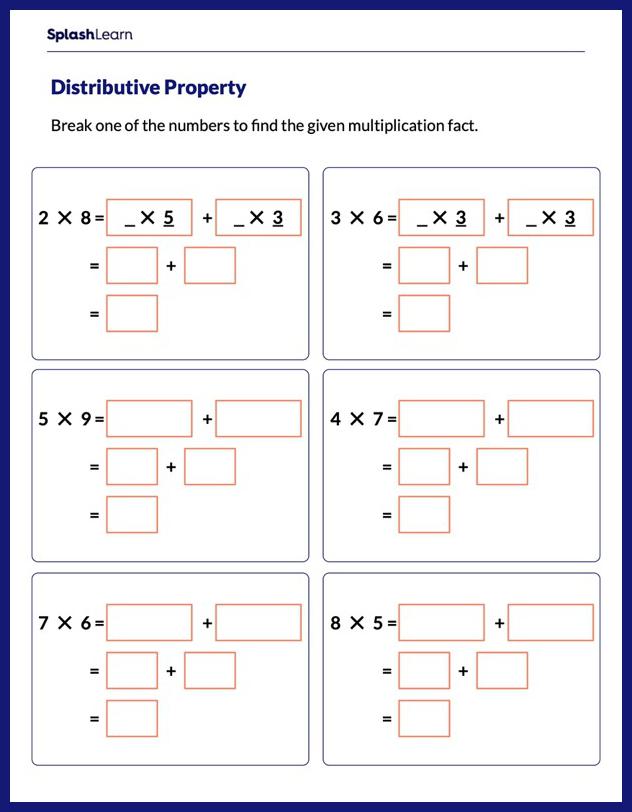
Developing strong mathematical foundations is crucial for academic success and real-world application. Often, the challenge lies in making abstract mathematical concepts accessible and enjoyable for learners of all ages. Innovative educational tools are essential in transforming this perception, turning potential struggles into opportunities for discovery. Engaging activities designed for easy replication provide a dynamic approach to reinforce understanding, build essential skills, and cultivate a positive attitude towards numerical challenges. These resources bridge the gap between rote memorization and true comprehension, fostering an environment where learning feels less like a chore and more like an exciting exploration. Explore more in our Math Worksheets collection.
💡 Educational Key Takeaways:
- Core Skill: Structured Maths Games To Print focused on developing pencil grip, stroke control, and early literacy/math confidence.
- Target Scope: Suited for homeschoolers, preschool, kindergarten, and elementary learners.
- Best Recommendation: Practice 10–15 minutes daily with ergonomic writing tools to reinforce muscle memory without hand fatigue.
The strategic incorporation of interactive mathematical resources offers significant advantages in the learning process. These materials are instrumental in promoting active engagement, which is far more effective than passive reception of information. They support the development of critical thinking by requiring learners to devise strategies and solve problems creatively. Furthermore, such activities can significantly reduce math anxiety by presenting concepts in a playful, low-pressure format, thereby increasing confidence. Skills such as arithmetic proficiency, logical reasoning, pattern recognition, and even basic strategic planning are naturally honed through repeated interaction with these varied challenges. This approach ensures that learning is multi-faceted, catering to different learning styles and encouraging a deeper grasp of mathematical principles. For more related activities, check out our Math All About Me Worksheet.
Typically, these educational resources are structured to be user-friendly and highly adaptable. Common formats include game boards that require dice and counters, puzzle grids demanding logical deduction, challenge cards posing specific problems, and interactive sheets for various arithmetic operations. Content ranges from fundamental number recognition and counting exercises for younger learners to complex algebraic puzzles and geometry challenges for more advanced students. Many sets feature clear, concise instructions to facilitate independent use and often include answer keys, allowing for self-correction and immediate feedback. The versatility in structure ensures that there is a suitable activity for almost any mathematical topic or learning objective, making them an invaluable addition to any educational toolkit. Discover more free resources across our collection library.
To maximize the effectiveness of these interactive learning tools, a structured approach is recommended. First, carefully select activities that align with the learner’s current skill level and specific learning goals to ensure an appropriate challenge. Next, ensure all necessary materials, such as a printer, paper, writing implements, and any game components like dice or counters, are readily available. Encourage full engagement by explaining the rules clearly and facilitating initial play to build understanding. During and after the activity, prompt discussion about strategies used and solutions found, connecting the mathematical concepts to real-world scenarios whenever possible. Adapt the complexity if needed, simplifying or extending challenges to maintain interest and ensure continuous progress. Consistent, regular use of these engaging activities reinforces learning and embeds concepts more securely.
Expanding the use of these educational printables can further enrich the learning journey. Consider varying the types of activities regularly to keep interest high and expose learners to different problem-solving methods. Incorporate positive reinforcement to celebrate effort and progress, building a supportive learning atmosphere. These versatile resources can be utilized effectively in various settings, from a structured classroom environment to relaxed home learning sessions. Pairing these hands-on activities with complementary online tutorials, educational videos, or physical manipulatives can create a robust, multi-sensory learning experience. Exploring themed or seasonal variations of these puzzles and games can also add an extra layer of enjoyment and relevance, keeping the content fresh and exciting.
The strategic deployment of engaging mathematical resources profoundly transforms the learning experience, moving beyond conventional methods to foster genuine interest and proficiency. These printable activities are powerful instruments for reinforcing core concepts, enhancing problem-solving abilities, and building learners’ confidence in their mathematical capabilities. By making learning interactive and enjoyable, they cultivate a lasting appreciation for numbers and logic. Individuals are encouraged to explore, download, and integrate these beneficial learning tools into their educational routines, discovering the numerous possibilities for making mathematical understanding a consistently rewarding endeavor.
Developmental Milestone & Activity Table
| Development Stage | Recommended Daily Duration | Primary Learning Objective |
|---|---|---|
| Preschool & Pre-K | 10 – 15 Minutes | Pencil grip development & basic pre-stroke lines |
| Kindergarten | 15 – 20 Minutes | Letter/number formation & spatial line awareness |
| Early Elementary (Grade 1–2) | 20 – 30 Minutes | Fluency, sentence construction & neatness |